



















 Earn up to 50% APR
 Boost earnings with NFTs
 Play, HODL & earn more







Can You Actually Retire with Bitcoin by 2030? Here Is What the Math Says
-
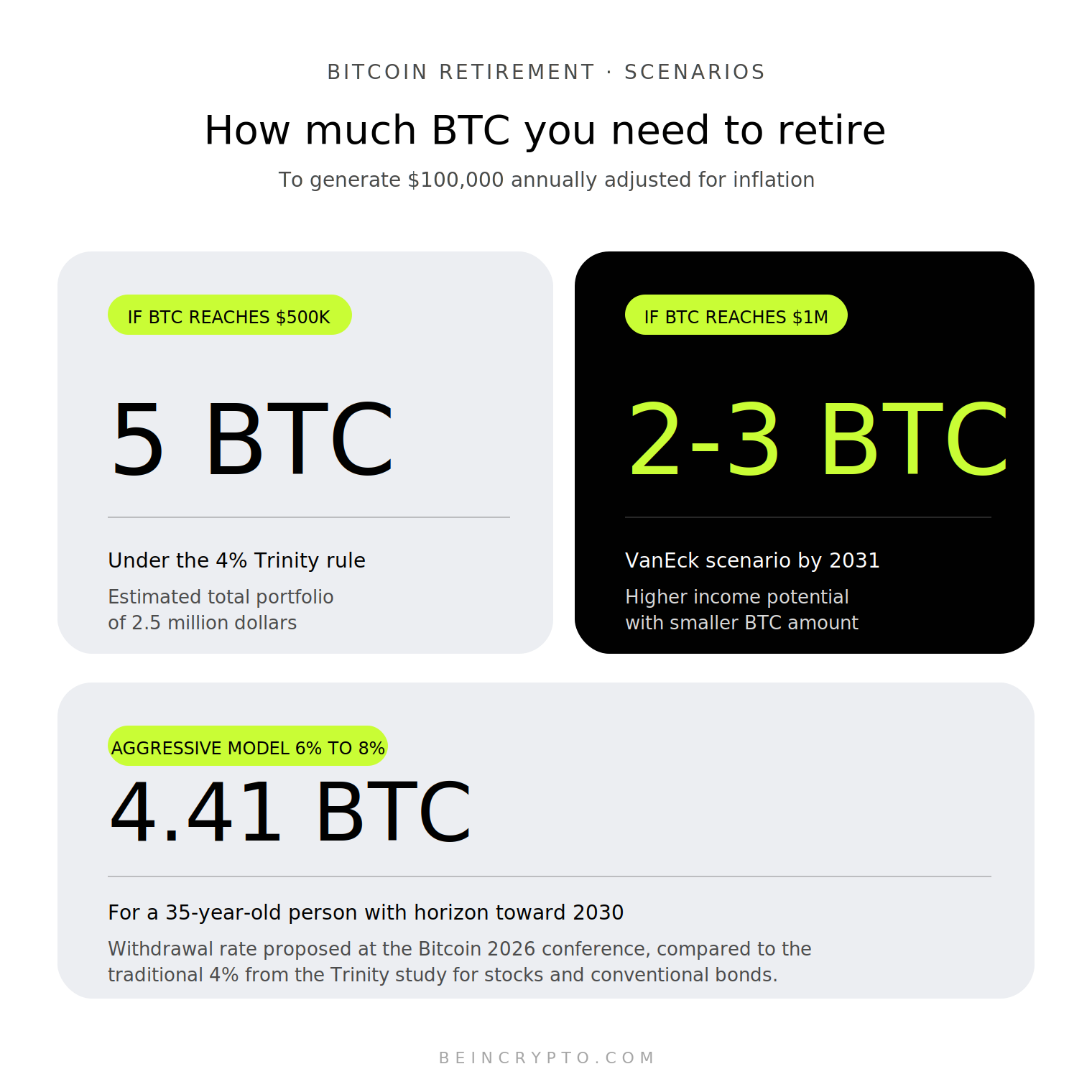
The question of whether Bitcoin can replace a traditional retirement portfolio is no longer purely theoretical. Based on the standard 4% withdrawal rule from the Trinity Study — which suggests an investor seeking $100,000 annually needs approximately $2.5 million accumulated — the number of BTC required to retire depends almost entirely on where the price lands by 2030. VanEck's Matthew Sigel has called $1 million per Bitcoin by 2031 the firm's base case, driven by demographic trends and sustained institutional buying. Michael Saylor projects the same level, while Cathie Wood at ARK Invest targets $1.2 million by 2030. More conservative but still bullish estimates from Standard Chartered, Bernstein, and Fundstrat place Bitcoin between $120,000 and $250,000 by end of 2026. If Bitcoin reaches $500,000 by 2030, 5 BTC would be sufficient to generate $100,000 annually under the 4% rule. More aggressive withdrawal models discussed at the Bitcoin 2026 Conference suggest 6% to 8% withdrawal rates given Bitcoin's appreciation potential, under which a 35-year-old investor might need only 4.41 BTC to generate the same $100,000 annually adjusted for inflation.
The institutional validation dimension adds credibility that individual price projections cannot replicate on their own. The New York State Common Retirement Fund, the Texas Teachers Pension Fund, and pension plans in Ohio, California through CalPERS, and Louisiana have all revealed exposure to Bitcoin through Strategy positions in recent reports. When public pension funds with 20 to 30-year investment horizons and rigorous approval processes allocate capital to Bitcoin exposure, it signals a qualitative shift in how the asset is being categorized within institutional portfolio construction — moving from purely speculative to a recognized alternative allocation within regulated retirement frameworks. US regulations expanding Bitcoin access in 401k and IRA accounts are simultaneously opening the door to trillions in retail retirement savings. The combination of institutional adoption and expanding retail access creates the sustained demand backdrop that underpins the bullish price projections — though neither guarantees them.