

















 Earn up to 50% APR
 Boost earnings with NFTs
 Play, HODL & earn more





NASA Accelerates Roman Telescope Launch as Astronomy Enters a “Data Explosion” Era
-
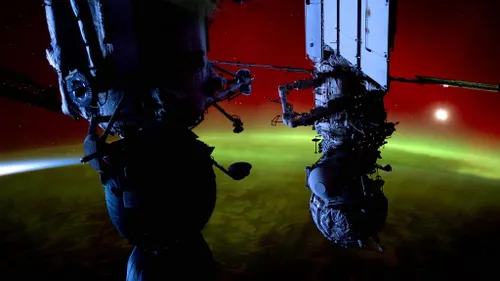
NASA has announced it will launch the NASA Nancy Grace Roman Space Telescope eight months ahead of schedule, targeting orbit in September 2026. The mission is expected to generate an unprecedented ~20,000 terabytes of scientific data over its lifetime, signaling how quickly space science is scaling into the era of big data astronomy.
The Roman telescope will join a rapidly expanding observational ecosystem that already includes the James Webb Space Telescope, which streams about 57 GB of imagery daily, and the upcoming survey work from the Vera C. Rubin Observatory in Chile, projected to produce roughly 20 TB of data every night.
For comparison, the Hubble Space Telescope produces only 1–2 GB per day—highlighting just how dramatic the jump has become.
This surge in data is fundamentally changing how astronomy is done. Researchers are no longer manually inspecting small datasets; instead, they’re relying on GPUs and AI systems to process cosmic-scale information streams. Tools like deep learning models are now being used to identify galaxies, analyze structure formation, and even enhance ground-based telescope images distorted by Earth’s atmosphere.
As one researcher described it, the field is shifting from “looking at a few objects” to running GPU-accelerated, AI-driven analysis across the entire observable universe—forcing universities and labs to compete for limited compute resources just to keep up.
With Roman launching early and Rubin and Webb already in motion, astronomy is entering a phase where the biggest bottleneck isn’t telescopes anymore—it’s compute.
-
AI doing galaxy classification at scale isn't optional at this data volume — it's the only viable path. The question is how you validate a deep learning model's discoveries when the ground truth is literally unknown. That's a serious epistemological problem for the field.