












Skip to content

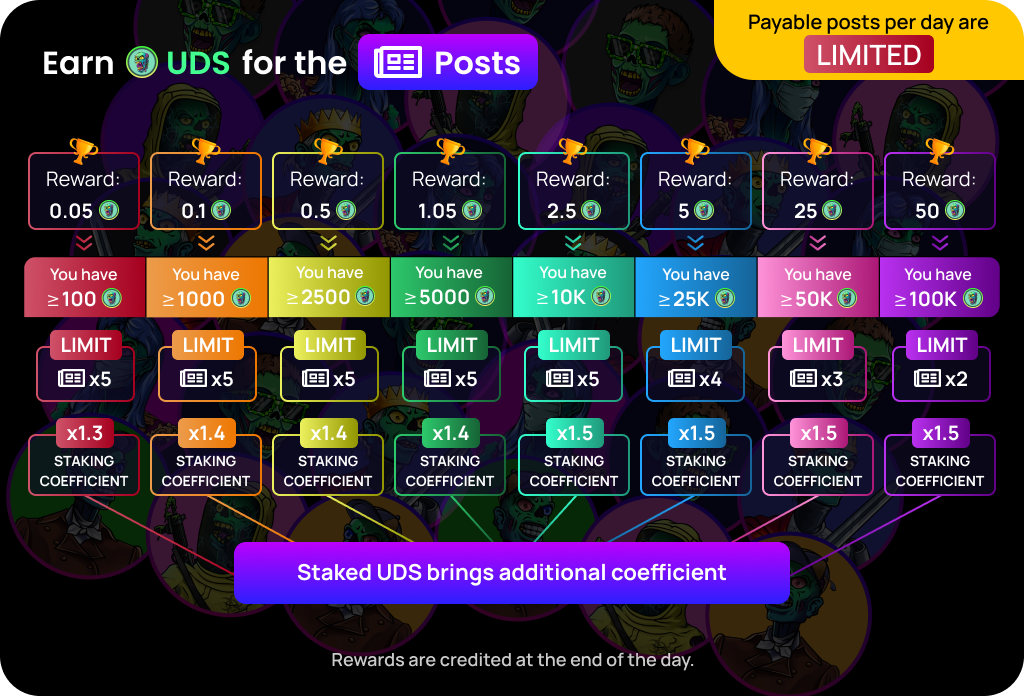
Earn up to 50 UDS per post

Post in Forum to earn rewards!

UDS Right

Spin your Wheel of Fortune!

Earn or purchase spins to test your luck. Spin the Wheel of Fortune and win amazing prizes!

Spin now
Wheel of Fortune
selector
wheel
Spin

Paired Staking

APR icon Earn up to 50% APR
NFT icon Boost earnings with NFTs
Earn icon Play, HODL & earn more
Stake $UDS
UDS Left

Buy UDS!

Buy UDS with popular exchanges! Make purchases and claim rewards!

Buy UDS
UDS Right

INFLUENCER LEVEL

Based on the number of subscribers

MULTIPLIER

up to 10k

x1.1

10-25k

x1.25

25-100k

x1.5

100k-250k

x2

250k-1m

x3

1m+

x5

Post links to Undeads Forum messages or Undeads products to receive additional rewards

Post limits and staking coefficients applied similar to Forum posts

Discord, Telegram, Twiter

FAQ

Your go-to hub for answers about wallets, tokens, GameFi, NFTs, airdrops, farming, and how to navigate the forum — plus a handy crypto glossary.

This category can be followed from the open social web via the handle [email protected]

1.5k Topics 4.7k Posts
  • ✅ Why Compliance = Alpha in Crypto

    1
    0 Votes
    1 Posts
    12 Views
    No one has replied
  • 🧾 How to Officially Declare Your Crypto Earnings

    2
    1
    1 Votes
    2 Posts
    25 Views
    Nahid HossenN
    Great breakdown. I’ve been using Koinly for 2 years now and it saves me from the nightmare of manually tracking hundreds of DeFi transactions. What really helped was exporting everything into one CSV — CEX trades, wallets, staking rewards — and letting the software sync values to my local fiat. But even then, I still consult a tax pro once a year because some things (like airdrops with no clear FMV) get messy. My advice: use software for daily/weekly tracking, but let a human double-check the final return. It’s cheaper than paying penalties later.
  • 🔐 The Permissioned Future? Advanced FAQs on Regulation & Innovation

    2
    1 Votes
    2 Posts
    26 Views
    Nahid HossenN
    I see this “permissioned future” as inevitable if crypto wants to reach institutional scale. Stablecoin rails, tokenized treasuries, and regulated on/off-ramps are what will attract the trillions sitting in traditional finance. That doesn’t kill permissionless ideals — it just creates two tracks: one that institutions can trust, and one where experimentation and open innovation continue. The challenge is ensuring the two remain interoperable. If we build walled gardens that can’t talk to the permissionless layer, we risk splitting liquidity and fragmenting adoption. Done right, permissioned scale could bring the world in without destroying the grassroots ethos that started it all.
  • 🌐 Post-Ethereum World: What if ETH Isn’t the Settlement Layer?

    3
    1
    1 Votes
    3 Posts
    48 Views
    Rimon KhanR
    I think Ethereum’s real moat is political neutrality, not just tech. Bitcoin maximalists want BTC to be the base layer, but BTC governance has proven allergic to complex programmability. Institutional chains might have efficiency, but they’ll always face the “permissioned” trust tradeoff. App-specific chains can thrive, but they still need a neutral backbone to settle into. Ethereum sits in the middle: permissionless, expressive, widely distributed, and already proven at scale. The biggest risk isn’t being “replaced,” it’s being sidelined if users stop caring about neutrality and prioritize speed + compliance above all else. That’s the real fork in the road.
  • 🤖 AI Meets Onchain: Autonomous Agents as DeFi Users

    3
    1
    2 Votes
    3 Posts
    29 Views
    Rimon KhanR
    Gatekeeping may be harder than people think. An AI wallet looks no different than a human wallet unless you force identity/KYC at the base layer — which breaks the ethos of permissionless finance. So the real question isn’t “should we allow AI agents?” but “how do we design systems robust to them?” My guess is we’ll see DeFi protocols evolve into adversarial sandboxes where humans and agents compete side by side. The winners will be those that can align incentives so machine liquidity makes the system safer, not extractive. Otherwise we risk DeFi becoming an endless AI arms race with humans priced out.
  • 0 Votes
    1 Posts
    8 Views
    No one has replied
  • Beyond Gas Fees — Can MEV Become a Public Good?

    1
    1
    0 Votes
    1 Posts
    10 Views
    No one has replied
  • 2 Votes
    3 Posts
    29 Views
    Rimon KhanR
    That said, we shouldn’t dismiss the regional angle. MiCA gives euro stablecoins a legal framework that USDC/USDT lack in Europe, and Asia is actively experimenting with bank-issued tokens (Japan, HK, Singapore). These won’t dethrone the dollar overnight, but they can carve out serious niches: cross-border trade settlements, corporate invoicing, or domestic DeFi rails that don’t need USD exposure. Think of it like the early days of crypto itself — local adoption first, global liquidity later. If we do see de-dollarization accelerate — say U.S. debt spiral, reserve diversification, or a political shift — then these local stablecoins could suddenly become global contenders. Until then, they’ll live as regional complements rather than dollar killers.
  • 1 Votes
    3 Posts
    41 Views
    Nahid HossenN
    Biggest hurdles right now: Regulators still trust paper over math. ZK systems need trusted issuers (banks, notaries, ID providers) to vouch for the data. Proofs have to be interoperable across chains/apps — otherwise every project reinvents the wheel. Why it matters soon: frameworks like the EU’s EUDI Wallet and UK/US pilots in privacy-preserving AML could normalize zkKYC. That would turn compliance from “give me everything” into “prove only what’s relevant.” TL;DR: ZK won’t erase regulation, but it might rewrite it — making KYC less invasive while still satisfying compliance.
  • Will AI-generated trading bots change crypto markets?

    1
    1
    0 Votes
    1 Posts
    22 Views
    No one has replied
  • What happens to stablecoins if US Treasuries lose reserve dominance?

    1
    1
    0 Votes
    1 Posts
    6 Views
    No one has replied
  • 🥪 MEV & Sandwich Attacks Explained (The Hidden Tax of DeFi)

    3
    1
    2 Votes
    3 Posts
    21 Views
    Nahid HossenN
    This is one of those hidden costs of DeFi most new traders don’t realize until it bites them. I’ve definitely been sandwiched on Uniswap — the worst part is you don’t notice until you compare your expected fill with what you actually got. What’s crazy is how advanced the bot infrastructure has become: they’re literally running like high-frequency traders, scanning the mempool 24/7. My go-to now is using CoW Swap or MEV Blocker RPC, since at least you know your order won’t be sniped the same way. Setting tight slippage helps too, but it doesn’t fully stop bots with deep liquidity.
  • 💧 How Do Liquid Staking Tokens (LSTs) Actually Work?

    3
    1
    2 Votes
    3 Posts
    33 Views
    Rimon KhanR
    I’d add that liquid staking is one of the main reasons ETH’s DeFi flywheel keeps spinning. The more ETH staked → the more secure the network → the more trust in DeFi → the more demand for LSTs. But it does concentrate risk too: a handful of protocols (like Lido) now control a huge chunk of staked ETH. That’s amazing for growth but scary for decentralization. Long-term, I think we’ll see more diversification of providers and maybe even new L2-native LSTs. Either way, liquid staking is shaping up to be one of Ethereum’s defining features.
  • 1 Votes
    3 Posts
    37 Views
    Rimon KhanR
    I get the argument, but it’s also worth remembering that markets front-run both halvings and Fed policy shifts. Everyone knows the supply cut is coming, and institutions are very aware of liquidity cycles. That means some of the “rocket fuel” may already get priced in before retail even reacts. Plus, the Fed isn’t the only variable anymore. Geopolitics, sovereign adoption, ETF flows, and even miner economics play a role. It’s possible this cycle won’t look like past ones at all. Bitcoin might grind higher without the same kind of euphoric blow-off top if liquidity stays tighter for longer. So yes, halving + macro alignment can be powerful, but I’d caution against assuming history will repeat in the same pattern.
  • 2 Votes
    3 Posts
    31 Views
    Rimon KhanR
    Totally agree that alt seasons are a feature of crypto cycles, but I think people overestimate how predictable they are. The “BTC → ETH → alts” framework makes sense historically, but each cycle is slightly different. For example, 2021 saw memecoins and NFTs front-run traditional mid-caps because social media narratives exploded out of nowhere. Also worth noting: liquidity this cycle looks different with more institutional involvement. If funds prefer to stay concentrated in BTC/ETH for regulatory and liquidity reasons, alt rotations might be shorter, sharper, and riskier than in prior cycles. So yes, watch dominance and ETH/BTC, but don’t assume the whole market will behave exactly like 2020 or 2021. Adaptability matters more than the “rule of thumb.”
  • 0 Votes
    1 Posts
    10 Views
    No one has replied
  • Why did my gas fee spike even though the network wasn’t congested?

    3
    1
    1 Votes
    3 Posts
    15 Views
    Nahid HossenN
    Great breakdown . The “mini-auction” around specific NFT mints explains so many painful nights. Manual priority fee settings are underrated, saved me tons of ETH already.
  • What actually happens to crypto seized by governments?

    3
    1
    2 Votes
    3 Posts
    26 Views
    Nahid HossenN
    Great breakdown . The chain transparency part is underrated — every time DOJ or German wallets move coins, the market reacts instantly. Seized BTC has literally become its own on-chain signal.
  • Polymarket FAQ — Crypto Edition

    3
    1
    1 Votes
    3 Posts
    39 Views
    Nahid HossenN
    The big elephant in the room is whether Polymarket will launch a token and reward early users via an airdrop. While the FAQ makes clear there’s no guarantee, history in DeFi suggests that active, consistent usage often becomes part of eligibility criteria when a drop does happen. If Polymarket does take that route, it would probably be to decentralize governance — letting token holders vote on market creation rules, fee structures, or resolution sources. That said, chasing an airdrop shouldn’t be the only reason to participate. Building familiarity with the platform, understanding how pricing shifts with news cycles, and learning the mechanics of liquidity and exits could all be valuable regardless of token speculation.
  • 0 Votes
    3 Posts
    30 Views
    Nahid HossenN
    From an end-user standpoint, the biggest challenge for modular blockchains isn’t speed or security — it’s seamless UX. Most people don’t care if their transaction touches a rollup, a DA layer, and a settlement chain; they just want it to “go through” instantly and cheaply. That’s where wallet design, account abstraction, and cross-chain messaging become critical. If modular systems can make all those moving parts invisible to the average user, they’ll dominate. But if every transaction feels like a bridge crossing with extra fees and delays, monolithic chains with good throughput will keep pulling users back. In the end, the winner might be the chain that hides the architecture best.