


















 Earn up to 50% APR
 Boost earnings with NFTs
 Play, HODL & earn more





Grayscale Identifies Six Blockchains Set to Win the $300 Trillion Tokenization Opportunity
-
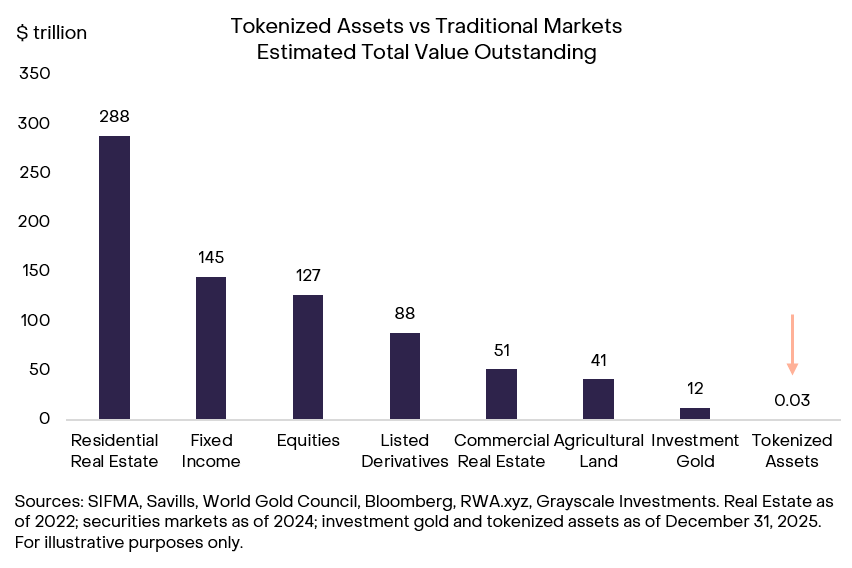
Grayscale Research has published a report identifying the six blockchain protocols it believes are best positioned to benefit from what it calls the tokenization megatrend: Ethereum, Solana, Canton, Avalanche, BNB Chain, and Chainlink. The context framing the opportunity is significant. The tokenized asset market has grown 217% year-over-year and now stands at approximately $30 billion, but that figure represents only around 0.01% of the roughly $300 trillion global equity and bond market. Grayscale's head of research Zach Pandl and analyst Will Ogden Moore describe this gap as an unfilled runway, arguing that much of the global securities market along with real estate and other asset classes will eventually migrate on-chain over time. US Treasurys lead current on-chain tokenized assets at approximately $15 billion, followed by commodities at around $5 billion, with private credit, funds, and equities representing smaller but growing categories.Canton is identified as the near-term leader given its institutional architecture.
The network commands 93.8% of total on-chain represented RWA value according to RWA.xyz data and hosts more than $390 billion in tokenized asset value, by far the largest pool of institutional capital in the sector. Its privacy-by-default design and structure built to mirror how traditional finance already operates make it the most natural entry point for institutions transitioning from legacy infrastructure. Ethereum holds the dominant position in the distributed RWA market with more than 54% market share and approximately $16 billion in tokenized assets, while Solana trails with over $2 billion but offers throughput above 1,000 transactions per second and lower costs that Grayscale sees positioning it well for retail-accessible use cases like on-chain consumer stock trading. Chainlink is identified as the premier infrastructure play, providing critical middleware at every stage of a tokenized asset's lifecycle regardless of which underlying blockchain captures the most volume.