

















 Earn up to 50% APR
 Boost earnings with NFTs
 Play, HODL & earn more





Tezos Just Launched a Quantum-Resistant Private Payment System on Testnet
-
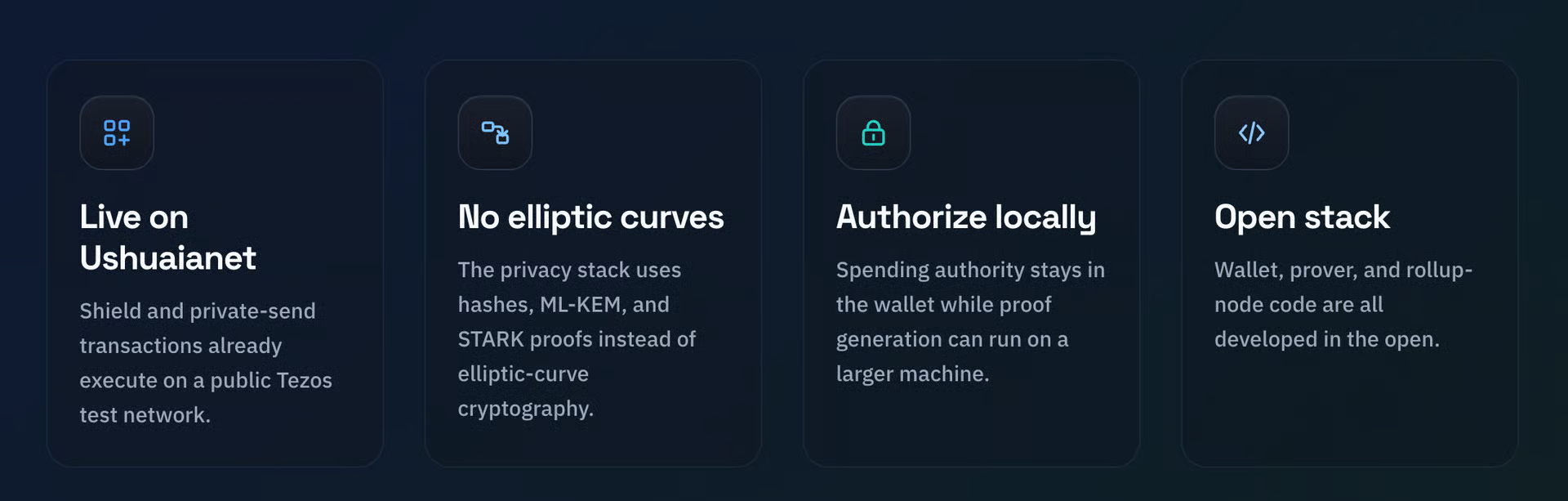
Developers behind the Tezos ecosystem have launched a testnet prototype called TzEL, a private blockchain payment system designed to resist quantum computing attacks using post-quantum cryptography and zk-STARK proofs. The system protects transaction data and encrypted payment metadata against a specific threat known as "harvest now, decrypt later" attacks — a strategy where adversaries collect encrypted blockchain data today with the intention of decrypting it in the future once quantum computers become powerful enough to break current cryptographic standards. TzEL addresses one of the main technical barriers to building quantum-resistant privacy systems at scale: the much larger proof sizes that post-quantum cryptography requires. The quantum-resistant zk-STARK proofs used by TzEL are approximately 300KB in size, significantly larger than the privacy proofs used in existing blockchain systems, and the prototype handles this by using Tezos' Data Availability Layer specifically built to accommodate the expanded proof sizes without compromising scalability.
TzEL is currently live on the Tezos testnet and remains in active development, with the broader Tezos ecosystem still in the early stages of transitioning toward post-quantum cryptographic standards across its full infrastructure. The launch represents one of the more technically concrete responses to quantum computing concerns in the blockchain space — combining privacy features with quantum resistance in a single system rather than treating them as separate problems. The harvest now, decrypt later threat model is particularly relevant for private transactions because even encrypted data recorded on a public blockchain today creates a permanent record that could be exposed if quantum capabilities advance to the point where current encryption becomes breakable. By building quantum resistance into the privacy layer from the ground up rather than retrofitting it later, TzEL is attempting to address a vulnerability window that most blockchain privacy systems currently ignore entirely.