



















 Earn up to 50% APR
 Boost earnings with NFTs
 Play, HODL & earn more







Whitehat Hackers Are One of DeFi's Most Underappreciated Security Layers. The Renegade Incident Shows Why
-
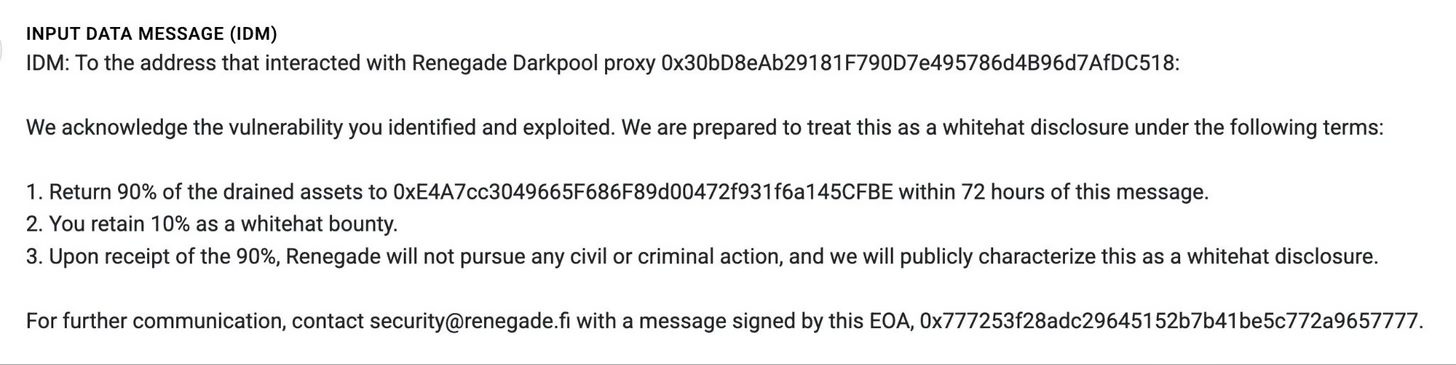
The onchain message that Renegade sent to the hacker. Source: ArbiscanThe Renegade.fi exploit and rapid recovery illustrates something the DeFi security community has been arguing for years: whitehat hackers, despite the ethical ambiguity of their methods, have become a genuinely important layer of protection for DeFi users in an environment where malicious actors are better resourced and more sophisticated than most protocol security teams. The distinction the Renegade hacker drew in their onchain response is worth taking seriously: they explicitly noted that North Korean state-backed hackers "would never come to negotiate," pointing to a real bifurcation in the attacker landscape between security researchers who exploit vulnerabilities to expose and return funds, and criminal operations that exploit the same vulnerabilities with no intention of returning anything. When a protocol has a vulnerability that is, in the hacker's words, "tooooo simple and bad," the question is not whether someone will find it but whether the person who finds it first is willing to negotiate or simply takes the money and routes it through a mixer.
The infrastructure supporting whitehat activity in DeFi has formalized significantly in recent years. The Security Alliance's Safe Harbor framework was specifically designed to give whitehats legal protection when they drain vulnerable contracts for temporary safekeeping, addressing one of the primary barriers that previously discouraged security researchers from acting even when they identified critical vulnerabilities. Renegade's own response — an onchain message offering a 10% bounty and a path to avoiding legal consequences — follows a protocol that has become increasingly standardized across DeFi incident responses, reflecting the industry's recognition that negotiating a 90% return is dramatically better than the alternative of a complete loss to a malicious actor with no interest in communication. The broader lesson for DeFi protocols is that whitehat hackers are effectively providing free security auditing under adversarial conditions, and the combination of a generous bounty culture, clear legal protection frameworks, and rapid response communication creates the conditions under which those hackers choose negotiation over theft. Renegade's $190,000 recovery is a best-case outcome — and it happened because the protocol responded correctly once the exploit was detected, not because the underlying vulnerability was acceptable.