
















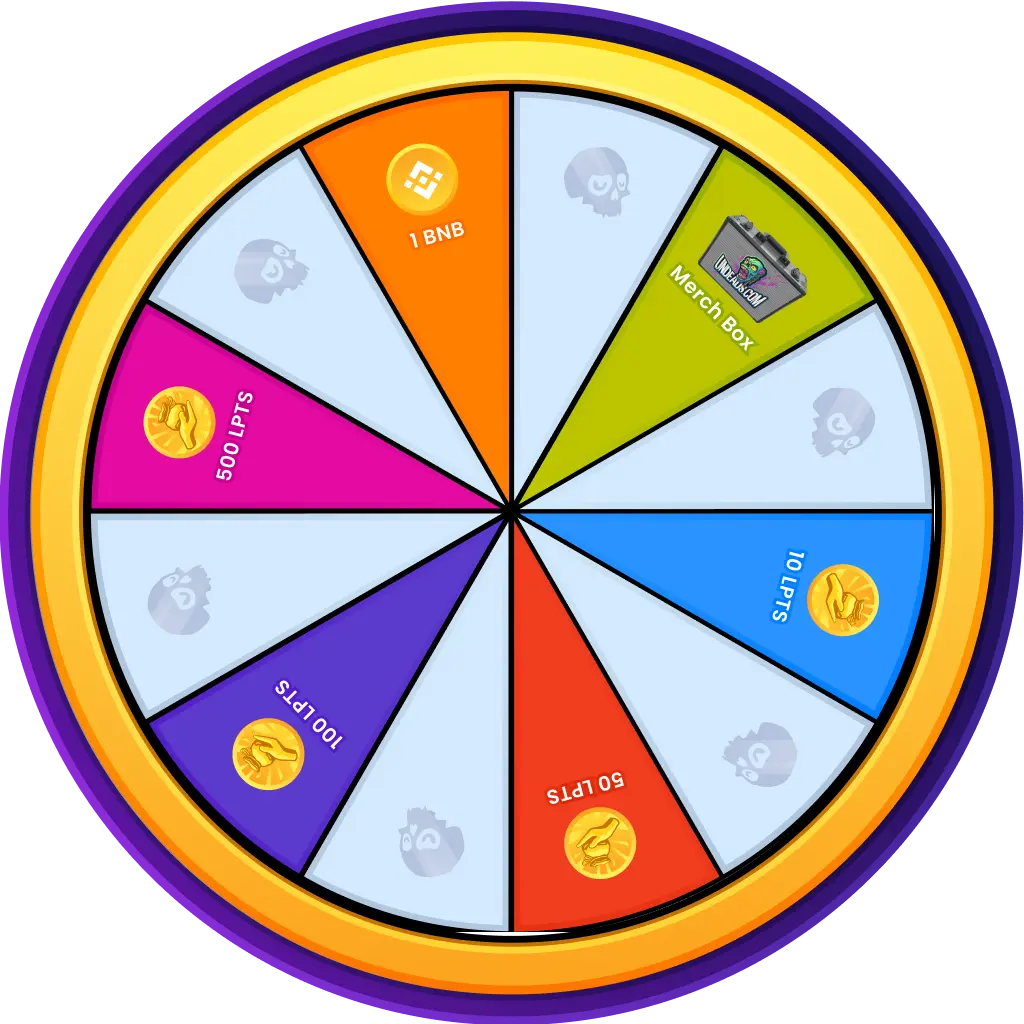

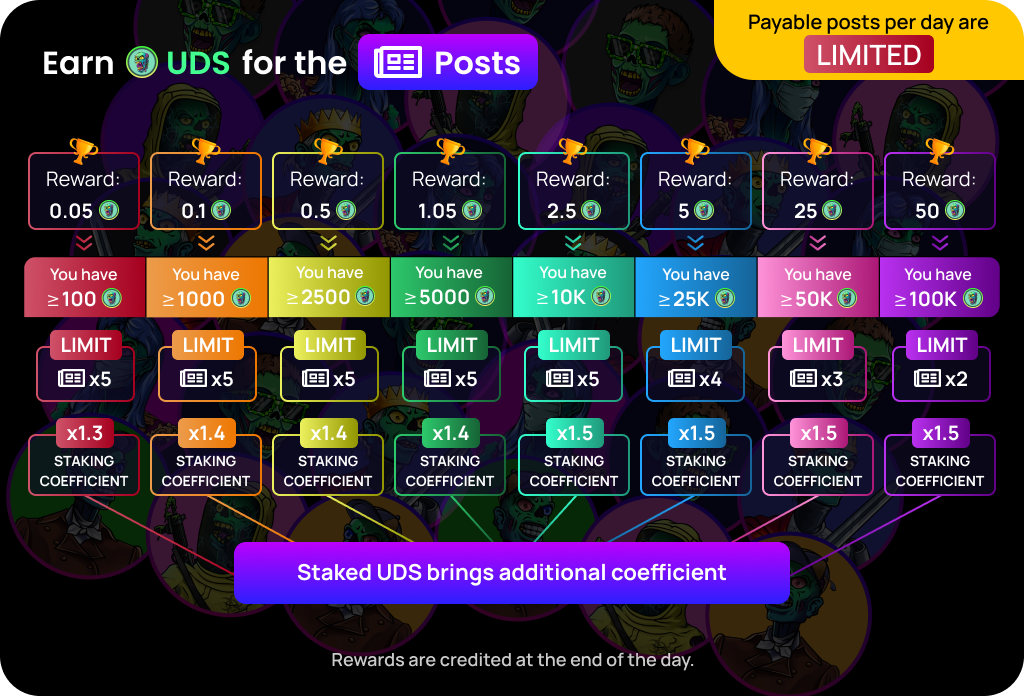
 Earn up to 50% APR
 Boost earnings with NFTs
 Play, HODL & earn more








 B
B
bcd8b07f7c
@bcd8b07f7c
Posts
-
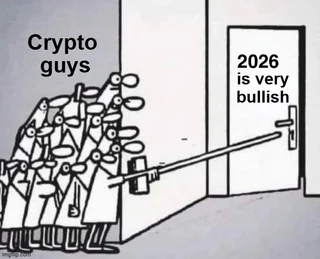
every family with crypto son gifting it -
we only hope for it -
okay boss -
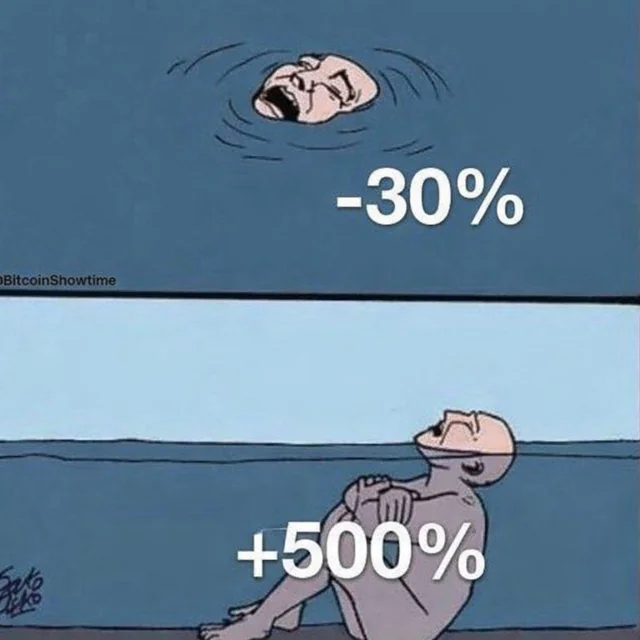
bruh you still made 69$ -
people who bought BTC in 2022 -
Bitchat Goes Viral: Search and Download Surge in Uganda
Interest in Bitchat has surged dramatically inside Uganda. Google Trends data shows searches for “Bitchat” jumping from near zero to peak levels, with queries like “Bitchat APK download” flagged as breakout topics. Downloads have crossed hundreds of thousands globally, with a sharp uptick in the days following Wine’s call.
Uganda isn’t the first case. Similar spikes occurred during protests in Madagascar, Nepal, and Indonesia, suggesting a pattern: when connectivity feels threatened, demand for decentralized communication tools explodes. As elections approach, Bitchat’s rise highlights how political pressure is reshaping the technology people trust to stay connected.
-
From Messaging Apps to Satellites: Uganda Tightens the Digital Space
Beyond social platforms, access to alternative connectivity is also under pressure. Recent reports indicate the Ugandan government has moved to restrict imports of Starlink equipment, which can provide high-speed connections independent of local infrastructure.Taken together, limits on satellite internet and threats of social media shutdowns suggest a broader effort to control information flows. In that environment, tools like Bitchat — which bypass both telecom networks and satellites — become especially attractive to those seeking uninterrupted communication.
-
A Familiar Playbook: Internet Blackouts and Uganda’s Elections
Concerns over a shutdown are rooted in history. During elections in 2016 and 2021, the government of President Yoweri Museveni blocked internet and social media nationwide, citing national security and public order. Human rights groups argue these blackouts disproportionately affect opposition movements that rely on digital tools to organize and monitor voting.
Wine alleges similar restrictions are planned for 2026, warning that cutting connectivity prevents citizens from verifying results and demanding accountability. Authorities maintain that such measures are lawful and necessary, but critics see them as a way to control narratives during politically sensitive moments.
-
Offline by Design: Why Ugandan Activists Are Turning to Bitchat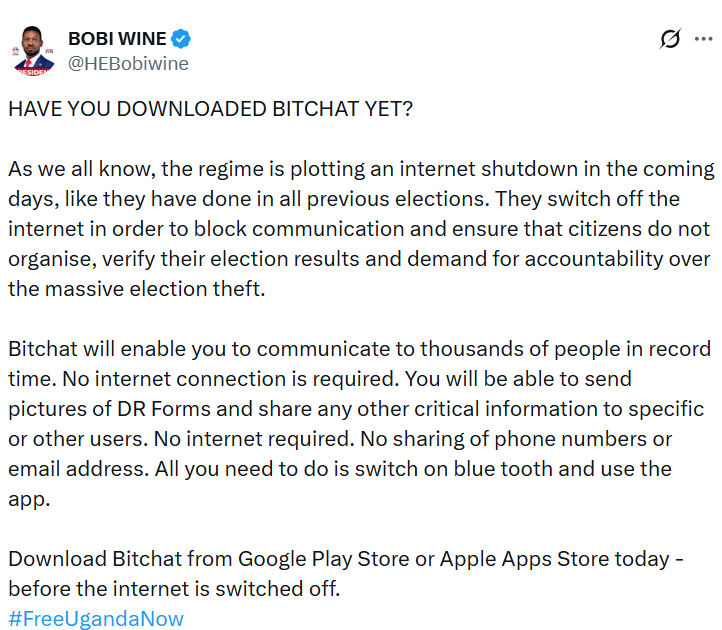
Ugandan opposition leader Bobi Wine is urging supporters to download Bitchat, a peer-to-peer messaging service created by Jack Dorsey, ahead of Uganda’s January 2026 presidential election. Wine claims authorities may shut down internet and social media access, a tactic used during past elections to disrupt communication and coordination.
Bitchat is designed to function without the internet, relying instead on encrypted Bluetooth mesh networks. With no central servers, phone numbers, or user accounts, it allows messages to hop from device to device — a structure that makes it difficult to censor. For activists, that design is not a feature but a necessity.
-
A New Phase in the Crypto ETF Race
Bitwise’s filing lands amid a wider surge of crypto ETF and ETP activity. Issuers such as Grayscale, VanEck, and 21Shares have all moved to expand offerings tied to individual altcoins and thematic sectors, signaling intensifying competition to define the next wave of crypto ETFs.
What sets Bitwise apart is scale: an 11-fund family built around a common framework rather than isolated bets. If regulators allow it, the move could normalize single-altcoin ETFs in the U.S. market and accelerate the shift from diversified crypto baskets toward more precise, conviction-driven products.
-
Inside Bitwise’s Strategy ETFs: Not Pure Spot, Not Futures
Bitwise’s proposed products are structured as “Strategy ETFs,” not plain spot vehicles. According to filings, each fund would invest up to 60% of assets directly in the underlying token, with at least 40% allocated to exchange-traded products that also reference that same asset.
This hybrid design allows the ETFs to blend spot holdings, ETP exposure, and potentially derivatives to fine-tune risk. The structure sets them apart from existing spot-only crypto ETFs and reflects a rules-based approach aimed at navigating liquidity, tracking, and regulatory constraints more flexibly.
-
From DeFi to AI: The Tokens Bitwise Wants in ETFs
The 11 proposed ETFs would cover a wide cross-section of the altcoin market, including Aave, Uniswap, Bittensor, Sui, and Near, among others. Together, they span decentralized finance, artificial intelligence, and next-generation base layers.
By launching the funds as a unified suite rather than one-off products, Bitwise is effectively making a bet on sustained investor interest in altcoins beyond Bitcoin and Ethereum. The strategy suggests that ETFs may increasingly be used to express specific crypto theses, not just broad market exposure.
-
Bitwise Pushes Deeper Into Altcoins With 11 New ETF Filings
Crypto fund manager Bitwise has filed with the United States Securities and Exchange Commission to launch 11 single-token “strategy” crypto ETFs, marking one of the most aggressive expansions yet into the altcoin ETF space. The move would give U.S. investors regulated exposure to tokens that have largely remained accessible only through crypto exchanges.
Unlike broad crypto index funds, each proposed ETF would focus on a single asset, signaling Bitwise’s belief that demand is shifting toward more targeted crypto exposure. If approved, the lineup would significantly broaden the ETF on-ramps available for altcoins across DeFi, AI, and layer-1 ecosystems.
-
A Ring for Thoughts—and a Glimpse of What’s Next
The latest expression of this thesis is Sandbar, a voice-activated ring designed to capture thoughts the moment they appear. Rather than replacing phones outright, it sidesteps them — offering a more natural interface for ideas, memory, and intelligence.
For Callaghan, this mirrors earlier successes: “It’s not about the device; it’s about the behavior.” As smartphones plateau and wearables grow at double-digit rates, True is betting that the next tech shift won’t live in our pockets — but on our bodies, woven quietly into how we think and act.
-
Betting on Behavior, Not Gadgets
True Ventures has a history of backing products that initially looked strange but ultimately reshaped behavior — from Fitbit to Peloton and Ring. In each case, the hardware mattered less than the habit it enabled.
This lens explains True’s quiet but effective strategy: small seed checks, high conviction, and repeat founders. With over 60 profitable exits and multiple IPOs, the firm has shown that ignoring hype and focusing on long-term behavior change can outperform louder, trend-driven investing.
-
The Smartphone Isn’t the Endgame
Jon Callaghan, co-founder of True Ventures, believes smartphones won’t be central to our lives in five years — and may be irrelevant in ten. This isn’t speculation. It’s an active investment thesis shaped by two decades of backing companies that changed how humans interact with technology.
Callaghan argues that phones are a poor interface for intelligence: disruptive, inefficient, and ill-suited for how humans actually think and communicate. As AI accelerates, he sees the real bottleneck not as intelligence itself, but how we access it — opening the door for entirely new interaction models.
-
That's why people started loving it -
well why is it in memes? -
BTC as a alarm -
Bruh when the realization hits you