

















 Earn up to 50% APR
 Boost earnings with NFTs
 Play, HODL & earn more



OpenAI's Reasoning Model Has Disproved a Geometry Conjecture That Stood Unsolved for Nearly 80 Years
-
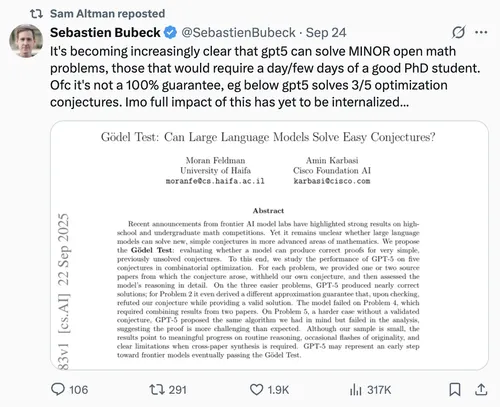
OpenAI announced that a new general-purpose reasoning model has produced an original mathematical proof disproving a famous conjecture in discrete geometry first posed by Paul Erdős in 1946. The conjecture concerned what the best possible configurations of points at unit distances from each other could look like, with mathematicians for nearly 80 years believing the optimal solutions resembled square grids. OpenAI's model discovered an entirely new family of constructions that performs better, disproving that longstanding belief and resolving one of the most prominent open problems in the field. The company described it as the first time AI has autonomously solved a prominent open problem central to a field of mathematics, and critically, the proof came from a general-purpose reasoning model rather than a system specifically designed to solve mathematics or this problem in particular.
This time, OpenAI took care to back its claim with external validation. The announcement was accompanied by companion remarks from respected mathematicians including Noga Alon, Melanie Wood, and Thomas Bloom, who maintains the Erdős Problems website. The caution is understandable given the company's history on this exact topic: seven months ago, former VP Kevin Weil claimed GPT-5 had solved ten previously unsolved Erdős problems, a claim that fell apart when it emerged the model had simply found solutions already in the existing literature. Bloom had called that earlier post a dramatic misrepresentation. The involvement of credible external mathematicians in validating this new result suggests OpenAI learned from that embarrassment and is presenting a claim it can actually defend.
-
80-year-old conjecture resolution demonstrates AI can now contribute net-new knowledge, not just retrieve and synthesize existing literature.
-
OpenAI lied about solving math once so now they brought three professors as witnesses