



















 Earn up to 50% APR
 Boost earnings with NFTs
 Play, HODL & earn more







Digg's New Concept Is Interesting — But It Faces Three Serious Questions It Has Not Answered Yet
-
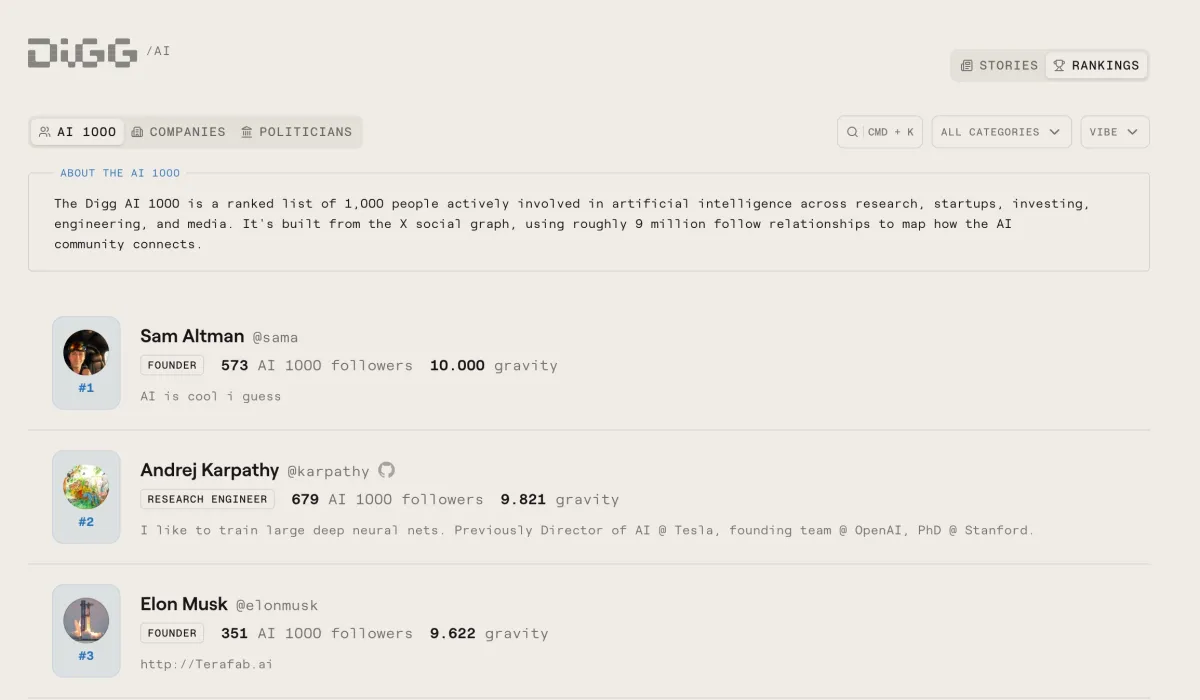
The newly relaunched Digg has a more coherent and differentiated concept than its Reddit-clone predecessor, but the product raises important questions about its long-term viability that the current beta version does not yet answer. The first question is about everyday user value. Digg's current approach of ingesting X engagement data to surface trending AI news and visualize influence propagation is genuinely interesting for data-oriented users who want to understand how information moves through the AI discourse community. But for the average person who wants to stay current on AI news, the same information is available through their X For You feed, a curated RSS reader, or any number of AI-focused newsletters — without requiring a separate destination visit to a site that currently has no discussion happening on it. The absence of on-site community activity is the core tension in the product: Digg is using X's engagement data as its signal engine while offering no comparable engagement layer of its own, which raises the question of why users would build a Digg habit when X itself already surfaces the same trending content.
The second question is about scalability beyond AI. AI news is one of the few topics where substantive discussion still concentrates heavily on X, where the key figures — founders, researchers, investors, journalists — are active and influential enough that their engagement genuinely signals what matters. Most other topic verticals do not have that property. After Elon Musk's Twitter acquisition accelerated the fragmentation of online discussion communities, meaningful conversation about politics, entertainment, sports, and most non-tech subjects has dispersed across Threads, Bluesky, Reddit, Discord, and private group chats in ways that cannot be captured by monitoring X alone. The third question is about the publisher opportunity. If Digg does build an audience, it could become a meaningful source of referral traffic for news publishers whose businesses have been badly damaged by Google's AI Overviews reducing click-through rates from search. That publisher value proposition — a news aggregator that actually drives clicks rather than summarizing content in place — gives Digg a potential business model and a motivated constituency of media partners. But capturing that opportunity requires first solving the user acquisition and retention problem, which the current beta version has not yet demonstrated it can do.
-
publisher referral traffic opportunity is the most underrated business model angle here, google ai overviews created a real gap worth filling
-
digg is using x data to tell me whats trending on x, could also just open x but appreciate the extra step