



















 Earn up to 50% APR
 Boost earnings with NFTs
 Play, HODL & earn more








AI Leaders Gathered at Milken 2026 — Here Are the Ideas Worth Paying Attention To
-
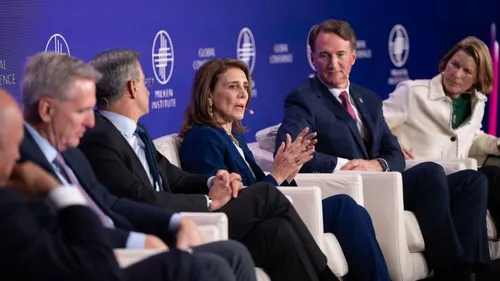
At the Milken Global Conference in Beverly Hills, five executives spanning every layer of the AI supply chain shared perspectives that cut through a lot of the usual hype. One of the more thought-provoking contributions came from Eve Bodnia, a quantum physicist turned startup founder, who is building AI on a fundamentally different architecture than the large language models dominating the industry. Her company, Logical Intelligence, uses energy-based models — systems that attempt to understand the underlying rules of data rather than predicting the next token in a sequence. Her largest model runs at just 200 million parameters compared to the hundreds of billions in leading LLMs, yet she claims it operates thousands of times faster and can update its knowledge as data changes without requiring full retraining. "Language is a user interface between my brain and yours," she said. "The reasoning itself is not attached to any language." As the AI field begins to question whether scale alone is sufficient, her approach is likely to attract growing attention.
On the geopolitical side, Applied Intuition CEO Qasar Younis made what may have been the panel's sharpest observation: physical AI and national sovereignty are entangled in ways that purely digital AI never was. Autonomous vehicles, defense drones, and agricultural machines manifest in the real world in ways governments cannot ignore, and nearly every country is signaling that it does not want AI operating in physical form within its borders if it is controlled by a foreign power. ASML's Fouquet added an important counterpoint — China's AI software progress is real and has alarmed parts of the industry, but without access to advanced chip manufacturing technology, models built on older hardware face a compounding disadvantage no matter how capable the software layer becomes. Taken together, the panel painted a picture of an industry that is simultaneously accelerating and running into hard walls — technical, physical, and geopolitical — all at the same time.