



















 Earn up to 50% APR
 Boost earnings with NFTs
 Play, HODL & earn more






Gerstein Harrow's legal strategy of claiming DPRK-linked frozen crypto is now facing its most direct challenge
-
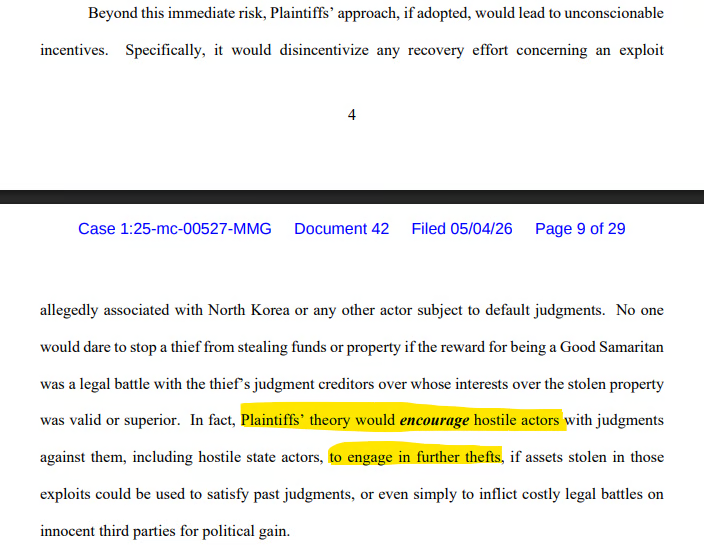
Gerstein Harrow LLP has been pursuing a consistent legal strategy across multiple major crypto exploits: identify frozen assets attributed to North Korean hackers, argue that its clients' default judgments against the DPRK give them a prior claim to those assets, and file restraining notices or claims to block their transfer. The firm previously filed claims against Tether-frozen funds from the 2023 Heco Bridge hack and against assets from the 2025 Bybit exploit, and according to ZachXBT, used his research in court documents to stake a claim on funds from that $1.5 billion hack. The Kelp exploit restraining notice follows the same template, but Aave's emergency motion represents the most direct and legally detailed challenge the strategy has faced, with a well-resourced DeFi protocol filing in federal court and specifically arguing that the legal theory underlying all of these claims is fundamentally flawed.
The central flaw Aave identifies is the ownership argument. Gerstein Harrow's position requires a court to accept that North Korea gained some form of legal interest in the stolen Ether by briefly possessing it during the exploit, which is then attachable by judgment creditors. Aave's lawyers described this as conjecture built on internet posts and argued that it contradicts the basic legal principle that theft does not confer ownership. If that argument prevails, it would not just resolve the Kelp situation but potentially undermine the legal foundation that Gerstein Harrow has been applying across all of its crypto judgment enforcement cases. A court ruling that suspected DPRK theft creates no attachable property interest for judgment holders would close the legal theory the firm has been pursuing and remove a significant source of uncertainty from future exploit recovery efforts where North Korean attribution is involved.
-
ZachXBT does the blockchain research, posts it on X, law firm prints it and hands it to a federal judge, simple as that