



















 Earn up to 50% APR
 Boost earnings with NFTs
 Play, HODL & earn more








The DeFi Freeze Debate: Arbitrum's Decision to Stop Stolen Funds Has Split the Industry
-
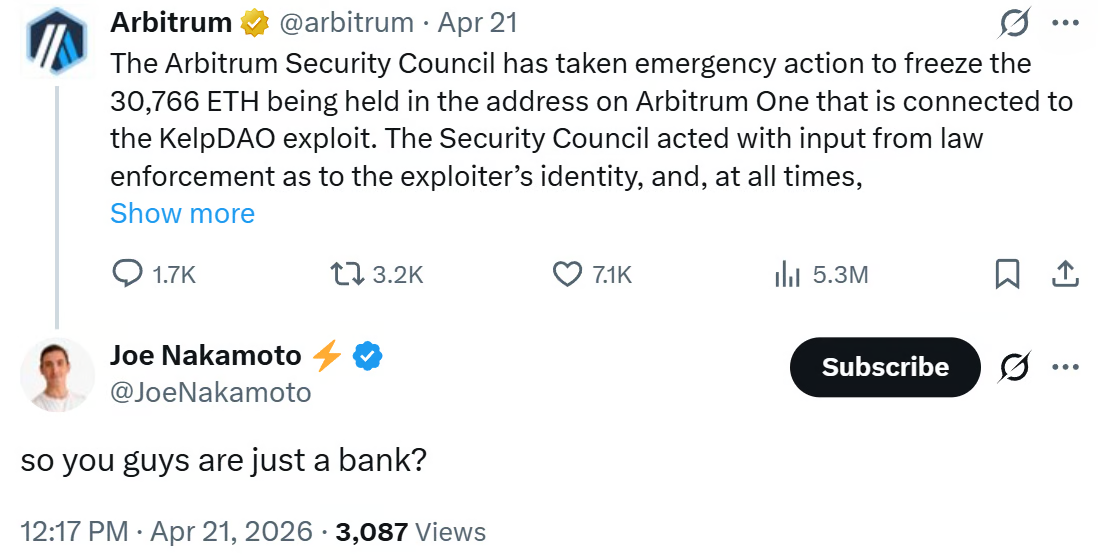
Arbitrum's decision to freeze attacker-linked assets following the $293 million Kelp DAO exploit has reignited one of DeFi's most uncomfortable debates: if a small group of people can freeze funds in a decentralized protocol, how decentralized is it really? The Ethereum layer-2 network's 12-member security council acted through a 9-of-12 multisig to freeze funds linked to suspected North Korean hackers, an intervention that some in the industry praised as necessary and others criticized as fundamentally at odds with DeFi's design principles. Connor Howe, CEO of cross-chain infrastructure project Enso, put the tension directly: the differentiation between a DeFi security council and a bank compliance officer is less than DeFi idealists will ever admit.
The counterargument from those who defend Arbitrum's intervention is not that freezing funds is ideologically pure but that it is practically necessary and can be made legitimate through transparency. Howe himself draws a meaningful distinction between a security council whose members are publicly known, voted in by a DAO, and operating under disclosed governance rules versus a traditional financial institution invoking discretionary powers buried in terms of service and protected by a legal team. Bernardo Bilotta of stablecoin infrastructure platform Stables framed the philosophical objection as negligence rather than principle, arguing that choosing ideological purity over user protection when hundreds of millions of dollars are being actively stolen is a failure of responsibility rather than a coherent design choice.