



















 Earn up to 50% APR
 Boost earnings with NFTs
 Play, HODL & earn more







The Litecoin Attack Highlights a Growing Threat to Low-Hashrate Blockchains and Cross-Chain Bridges
-
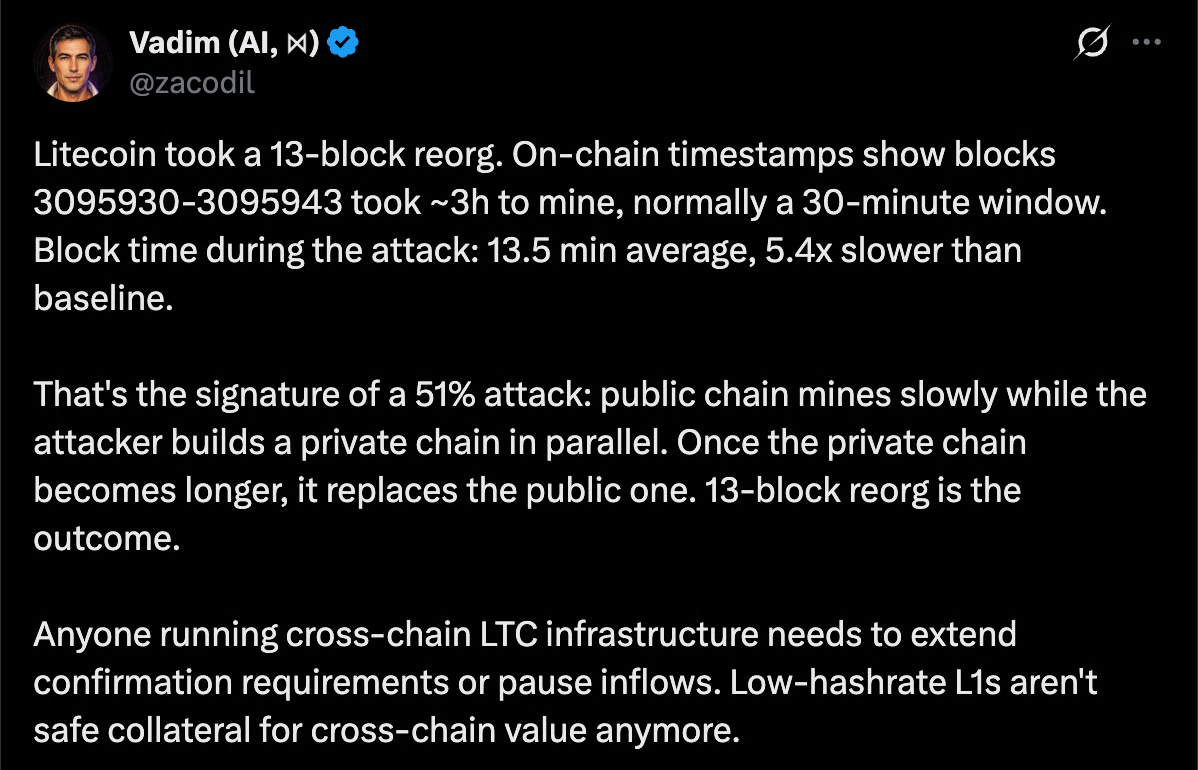
The Litecoin chain reorganization is the latest reminder that cross-chain infrastructure remains one of crypto's most persistently dangerous attack surfaces. The exploit specifically targeted the interaction between Litecoin's network and decentralized exchanges and cross-chain swap protocols, with the attacker using a software vulnerability to post invalid transactions before being reversed by a chain reorganization. Cross-chain bridges have cost the crypto industry billions of dollars in losses over the years, and the Litecoin incident follows closely on the heels of the April 18 Kelp restaking protocol exploit that drained approximately $293 million from the platform — underscoring that no layer of the cross-chain stack is immune.The broader context makes the incident more concerning. The rise of AI systems capable of identifying zero-day vulnerabilities at a scale and speed that outpaces human security researchers is increasing the frequency and sophistication of such attacks across the crypto ecosystem. For low-hashrate proof-of-work blockchains like Litecoin, the security model depends on sufficient mining power to make chain reorganizations prohibitively expensive — but as Vadim noted, targeted DoS attacks that temporarily suppress hashrate can create windows of opportunity that undermine that assumption entirely. The Litecoin team's rapid response and successful patch demonstrate that the network can recover, but the incident reinforces a growing consensus in the developer community that low-hashrate layer-1 chains carry structural security risks that cross-chain protocols and DeFi integrations need to account for explicitly.