

















 Earn up to 50% APR
 Boost earnings with NFTs
 Play, HODL & earn more



NEARUSDT – Symmetrical Triangle Breakout Incoming?
-
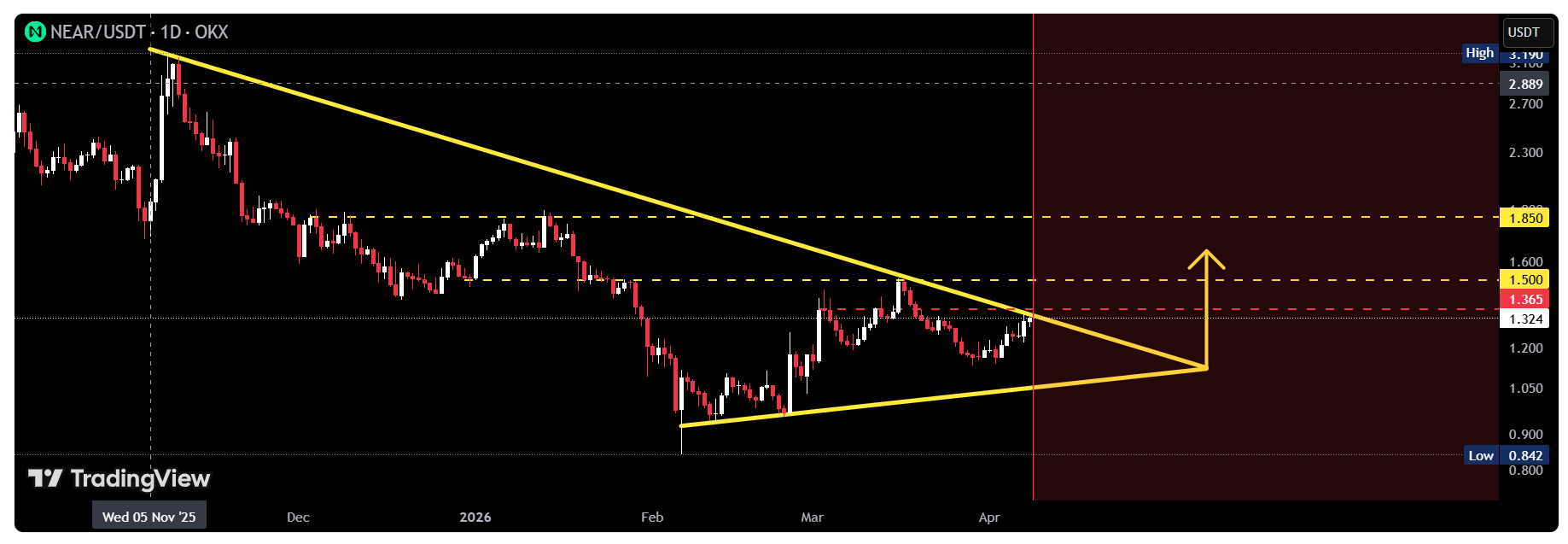
The NEAR/USDT pair is currently in a consolidation phase after a prolonged downtrend. Price structure is forming a Symmetrical Triangle, characterized by:Lower Highs (descending resistance trendline)
Higher Lows (ascending support trendline)
Price approaching the apex (convergence point) → indicating a major breakout is likely قريب
The previous trend was bearish, so statistically this pattern tends to act as a continuation pattern, but a bullish reversal remains possible if an upside breakout occurs.
 Pattern Explanation: Symmetrical Triangle
This pattern reflects a price compression phase between buyers and sellers:
Volume typically decreases as price approaches the apex
A breakout will determine the next major direction
Targets are usually projected based on the height of the pattern
 Bullish Scenario
If price successfully breaks above the resistance trendline, potential movement:
Break & close above the 1.36 – 1.50 zone
Upside targets:
 1.50 (first resistance) 1.85 (major resistance / key level)
Additional confirmation:
Successful retest of the breakout zone
Increasing volume
 ️ This would indicate a trend reversal from bearish to bullish
 Bearish Scenario
If price fails to break out and moves downward:
Breakdown below the support trendline
Loss of the 1.20 – 1.05 area
Downside targets:
1.05 (minor support) 0.84 (previous low / strong support)️ This would confirm a bearish continuation trend
 ️ Key Levels to Watch
Resistance:
1.36
1.50
1.85
Support:
1.20
1.05
0.84
 Conclusion
NEAR is currently at a critical phase. A breakout from the symmetrical triangle will determine the next major move.
Traders are advised to:
Wait for breakout confirmation
Avoid entering in the middle of the pattern (high noise zone)
Apply strict risk management
#NEARUSDT #CryptoAnalysis #TechnicalAnalysis #Altcoins #CryptoTrading #SymmetricalTriangle #BreakoutSetup #BullishScenario #BearishScenario #PriceAction #SupportResistance #CryptoSignals #DYOR
-
since the prior trend was bearish, continuation is statistically more likely, but triangles can still break either way